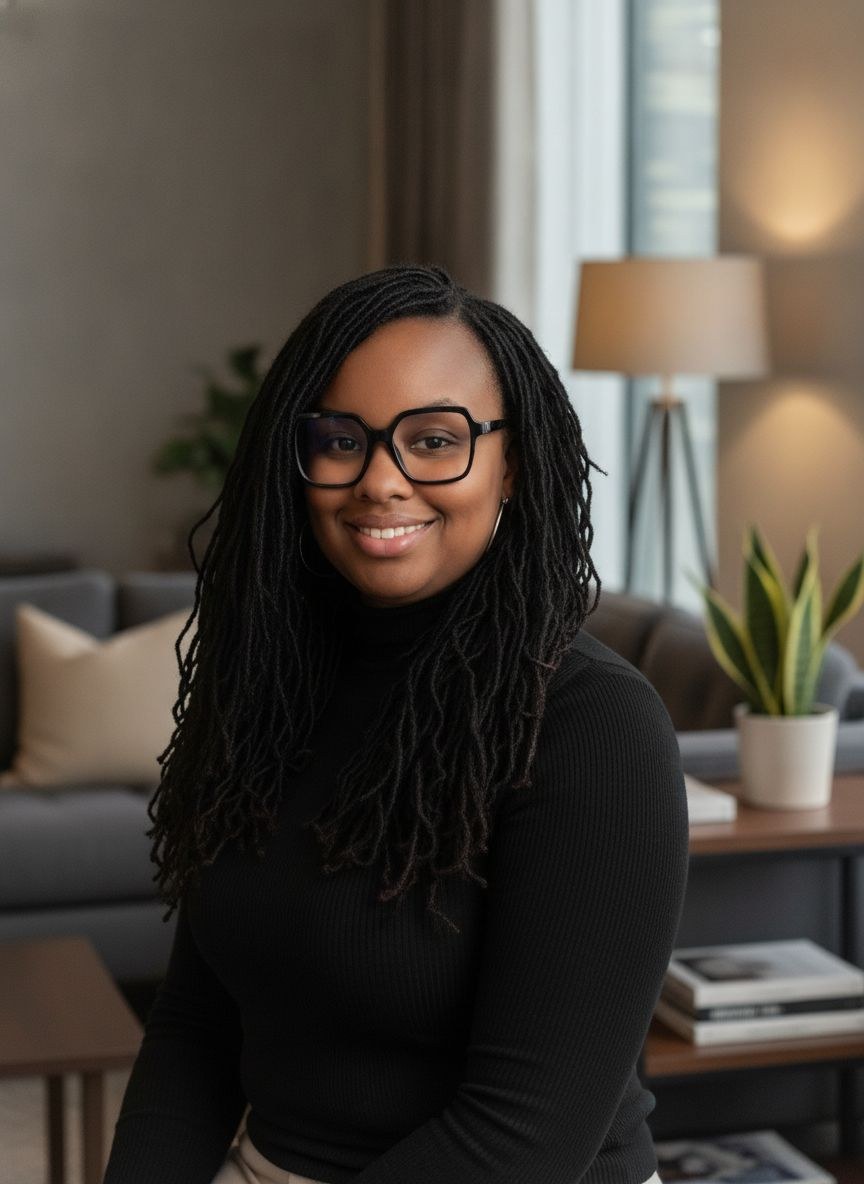
I work with couples in the work of repair and women through anxiety, burnout, identity shifts, and the everyday weight of holding too much. At Knoll Mind, we go below the surface together.
Licensed Clinical Social Worker · Doctor of Social Work
I came to this work because I watched too many women carry too much for too long without a place to put any of it down. The world tells women to be strong, to be everything, to keep moving. It rarely tells them where to rest.
I have been a social worker since 2006 and a licensed clinician since 2009. My doctoral work, my published research, and my classrooms at North Carolina Central University have all circled the same questions: how does pain settle in the body, how do cultural expectations bend a woman's sense of herself, and what does real healing look like when it includes the whole person.
Outside of practice, I am a wife and the mother of three sons, and most of my real life happens around our family table. I write a Substack about women's wellness and wellbeing because I believe the conversations Black women and women in general need to have should not stay behind closed doors. I read more nonfiction than I should. I am protective of my time. I believe in clinical rigor, plain language, and the quiet power of being seen by someone who is paying full attention.
You do not have to have it all figured out to begin.

A knoll is a small rise in the land, a place to pause and see further. I named this practice Knoll Mind because that is what therapy is — a place to set down what you have been holding, look at it honestly, and find your way forward. I built this practice for couples in the work of repair and for women navigating the demands of real life, knowing that race, body, family, faith, and the stories you have been told about yourself all walk in with you.
Your clarity begins here.
Healing is not a checklist. It is a partnership built on cultural attunement, clinical rigor, and the steady belief that every woman carries her own wisdom. My approach rests on four commitments.
Race, gender, faith, family history, and class shape the way pain is experienced and the way healing unfolds. I center the lived realities of women navigating racial stress, cultural expectations, and the demands of strength others have placed on them. Sessions hold space for the parts of your life that other therapists may have asked you to set aside.
I build care on Acceptance and Commitment Therapy, Narrative Therapy, Somatic practices, and Mindfulness-Based interventions. These are peer-reviewed, tested approaches with decades of research behind them. My own published work on ACT informs how I use these tools in session.
Stress, racial trauma, and the demands of being everyone's caretaker settle in the body. They show up as tight shoulders, shallow breath, restless sleep, hormonal shifts, and stomach knots no one names. I treat the body as a partner in healing, not a separate problem to manage on your own time.
I will never push you to disclose more than you are ready to share. The work moves at the speed your nervous system can hold. We revisit goals every few months and adjust as your life changes. This is your healing, not a treatment plan that runs on someone else's clock.
If you are a woman who keeps everything running and rarely lets anyone see the cost of that, you might be exactly who I work with. My clients show up for work, for their families, for their communities. They meet deadlines. They return calls. And they are tired in a way that a vacation does not fix.
Knoll Mind centers two clinical specialties, each backed by formal training and nearly two decades of practice.
Intentional work on communication, repair, and rebuilding trust, delivered via secure telehealth. I bring Gottman Method training to affair recovery, trauma between partners, and the everyday work of being in relationship. Sessions range from 50 to 75 minutes based on what the work requires.
I work with women managing anxiety, depression, burnout, perfectionism, identity transitions, and the cumulative weight of being everyone's caregiver. Care delivered via secure telehealth, designed for working professionals, mothers, partners, and the women who hold others up.
Both specialties are grounded in a BIPOC-affirming clinical framework. I name racial stress, cultural pressure, and the somatic toll these can carry. My PESI BIPOC Mental Health Specialist training informs how I show up in every session, with every client, regardless of specialty.
Reaching out to a new therapist is the hardest part. Once you do, here is what actually happens.
You email me at laviwilson@knollmind.com or book directly through Grow Therapy. I respond within one business day. No waiting weeks for a callback.
A brief conversation so I can hear what brought you here and you can hear my voice. I will ask what you are looking for in therapy. You can ask me anything. If we are a fit, we schedule your first full session. If not, I will help you find someone who is.
I send you a secure Zoom link before our session. The first ten minutes are paperwork — release forms, brief intake, confidentiality basics. Then we talk. I ask about what is bringing you in now, what you have already tried, and what you hope therapy can do for you. You set the pace. You share only what you are ready to share.
At the end of the first session, we talk about whether you want to continue. If you do, we discuss frequency — weekly, every other week, monthly — and start building your care plan together. No pressure to commit to a long-term contract. Therapy works because you choose it, not because someone locked you in.
If you are nervous, that is normal. Most clients tell me the first session feels less scary than they expected. The hardest part is sending the first message.
The approaches below shape how I work in session. Each one is chosen intentionally, grounded in evidence-based practice, and informed by nearly two decades of clinical experience, research, and advanced professional training.
I help clients build psychological flexibility through values-aligned action. My own published research on ACT informs how I teach and practice these skills in session.
Identifying unhelpful thinking patterns, challenging distorted beliefs, and developing healthier coping strategies for anxiety, depression, stress, and trauma recovery.
Stress and racial trauma live in the physical body. We work with your body as a partner in healing, restoring safety, regulation, and the connection between mind and body.
Practical mindfulness skills that reduce reactivity, strengthen emotional regulation, and build self-compassion. Research-supported and clinically tested with individuals, couples, and families.
Advanced training on the emotional, psychological, and physiological factors impacting women's mental health across the lifespan — anxiety, depression, trauma, perinatal concerns, burnout, and cultural pressures.
Culturally responsive clinical practice addressing racial trauma, intergenerational stress, and the therapeutic value of naming what many clients have been asked to keep quiet.
Evidence-based couples therapy training grounded in decades of research on relationship dynamics, conflict repair, affair recovery, and trust rebuilding.
I have been a social worker for twenty years and a licensed clinician for seventeen. I also serve as Associate Professor of Social Work at North Carolina Central University, where I teach the next generation of clinicians. My research focuses on the ways women carry stress in the body, the cultural expectations that bend a woman's sense of herself, and the silent weight of being expected to be strong. That research shapes everything I do in session.
| DSW | University of Tennessee–Knoxville |
| MSEd | University of Pennsylvania |
| MSSW | University of Wisconsin–Madison |
| BA | University of Connecticut · Psychology |
| LCSW | NC, SC, FL, DE, VT & ID fully active · IL, IN, VA pending |
| Harvard | Media & Medicine Certificate |
| Yale | Life Worth Living Faculty Fellowship |
My private practice experience began in 2010, when I served as Lead Licensed Outpatient Therapist at TASK Incorporated in Burlington, North Carolina. There I managed a full caseload and led clinical care for individuals navigating complex behavioral health concerns. These early outpatient years built the foundation for the depth I bring to private practice today.
Twenty years of clinical work means I do not flinch. Not at the size of what you or your partner are carrying, not at the contradictions in your story, not at the parts of your lives other clinicians have asked you to set aside. I bring calm, range, and the belief that what you have been holding deserves a real place to land.
Competitive self-pay rates and insurance-friendly booking. Everything you need to know before we start.
Priced for access. Trained at the highest level.
| Service | Self-Pay Rate |
|---|---|
| Individual Therapy · 45-min Intake | $120 |
| Individual Therapy · 45-min Ongoing | $120 |
| Individual Therapy · 60-min | $150 |
| Couples Therapy · 50-min | $120 |
| Couples Therapy · 75-min Extended | $150 |
Rates above reflect North Carolina self-pay sessions. State-specific rates will be posted as licensure is approved in additional states.
Self-pay rates as listed above. Pay directly through Grow Therapy at the time of session. No insurance involvement required.
I accept major insurance carriers including Aetna, Blue Cross Blue Shield, UnitedHealthcare, Cigna, and Medicare through Grow Therapy, which manages credentialing and billing across all carriers.
If your insurance is out-of-network, I provide a superbill you can submit to your insurance for possible reimbursement under your out-of-network benefits.
I partner with Grow Therapy as my booking platform. Grow manages credentialing and billing across major insurance carriers, and cash payments are welcome. The intake process stays seamless for you.
I am credentialed across additional therapy networks. Choose the platform that fits your insurance, location, or referral pathway.
I do not merely apply interventions. I investigate their efficacy and cultural relevance to ensure the highest standard of care for the women I serve.
Academic Site Full CV, teaching record, and faculty work ↗Kendall Hunt Publishing · Sole Author
Journal of Women's Health Care and Issues
in AI-Powered Leadership
IGI Global · Book Chapter
Journal of Psychology and Behavior Research
Behavioral Health News · Public Commentary
Clinical expertise meets personal storytelling
I partner with Grow Therapy for insurance billing, which covers Aetna, Blue Cross Blue Shield, UnitedHealthcare, Cigna, and Medicare. Cash pay is also welcome. If your insurance is not on Grow's list, I provide a superbill you can submit for possible out-of-network reimbursement.
The honest answer is, it depends. Some clients come in for a specific issue and finish in three to four months. Others stay longer because the work keeps unfolding. I do not run a one-size-fits-all treatment plan. We revisit your goals every few months and you decide when the work feels complete.
Most of my clients come in with at least some hesitation. Some have never been to therapy. Others have tried and stopped. You do not need to know what to say. You do not need a polished version of your story. You just need to be willing to show up. The first session is mostly me listening.
All sessions are virtual through a secure, HIPAA-compliant video platform. This means you can meet with me from your living room, your office, your car on a lunch break — anywhere you have privacy and a stable connection. Telehealth research shows outcomes are equal to or better than in-person care for most therapy work.
I am currently licensed and accepting clients in North Carolina, South Carolina, Florida, Delaware, Vermont, and Idaho. My licensure is pending in Illinois, Indiana, and Virginia, and I will begin accepting clients in each new state as the license clears. I cannot see clients in states where I am not licensed, even temporarily — this is a legal requirement, not a preference.
Yes. Couples therapy is one of my two clinical specialties. I bring Gottman Method training to my couples work, which means the approach is evidence-based and specifically strong in areas like affair recovery, trauma between partners, communication breakdown, and rebuilding trust. Sessions are 50 or 75 minutes based on what the work requires, and the pace is set by what both partners are ready to bring into the room.
Reach out by email or book directly through Grow Therapy to schedule a free 15-minute consultation. I respond within one business day.